Animals of Chobe National Park
What animals can you really see in Chobe? Beyond elephants, discover lions, leopards, buffalo, hippos, birds, and rare species—plus when and where to spot them.
Last updated: March 10, 2026
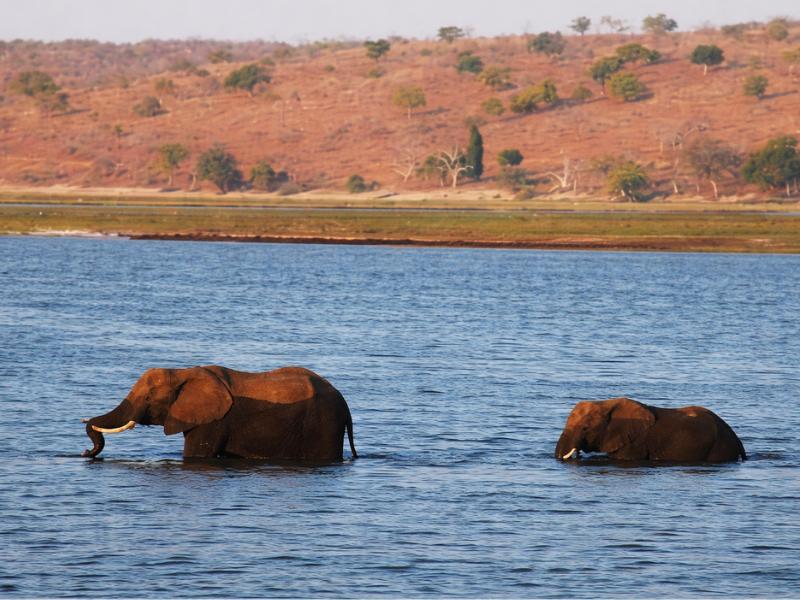
Chobe National Park is famous worldwide for elephants, with 50,000+ individuals creating the planet’s largest concentration and dominating tourism marketing with images of massive herds drinking at the river. Many visitors arrive expecting elephants and maybe a few other animals, then discover Chobe harbors incredible wildlife diversity including lions prowling riverfront ambush sites, elusive leopards hunting from riverine thickets, massive buffalo herds numbering thousands, resident hippo pods and giant crocodiles along the Chobe River, and 450+ bird species ranging from iconic fish eagles to rare Pel’s fishing owls. The elephant focus overshadows equally impressive wildlife making Chobe one of southern Africa’s most diverse parks beyond just its flagship species.
At Chobe Tours, our guides have spent years observing these animals across every season, understanding their behaviors, movement patterns, feeding habits, and where to find them during different months. This complete animal guide covers what you’ll actually see ranging from guaranteed elephants and hippos through highly probable lions and buffalo to moderately likely leopards and rare wild dogs, when to find different species during daily activity cycles and seasonal patterns, where animals concentrate across riverfront zones versus interior woodlands, and realistic expectations distinguishing common sightings from lucky rare encounters. We address big cats (lions, leopards, cheetahs, wild dogs), diverse herbivores (elephants, buffalo, giraffe, antelope), river giants (hippos, crocodiles), birds from fish eagles to carmine bee-eaters, and elusive rare species requiring patience and luck.
Chobe’s Wildlife Diversity
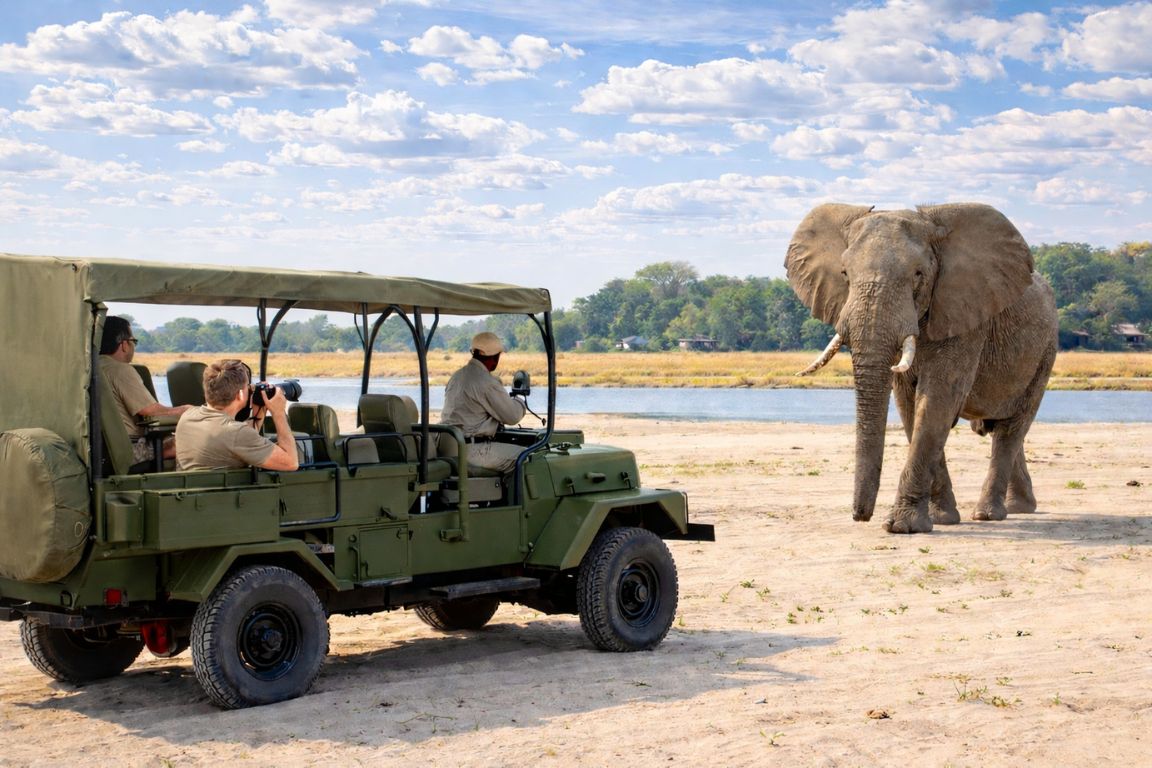
Why Chobe is special starts with the world’s largest elephant concentration at 50,000+ individuals creating daily spectacles of 200-400 animal herds impossible to witness anywhere else on Earth. The permanent Chobe River flowing year-round attracts wildlife during dry season when temporary water sources disappear across vast Kalahari landscapes, forcing animals to concentrate along narrow riverfront creating reliable viewing opportunities. The unique river ecosystem allows boat-based safaris alongside traditional vehicle game drives, providing water-level perspectives of hippos, crocodiles, and swimming elephants unavailable in landlocked parks.
Habitat diversity ranging from permanent river through seasonal floodplains to dry woodland supports varied wildlife communities, with different species specializing in specific zones creating comprehensive biodiversity within relatively compact accessible area. The trans-boundary elephant populations moving between Botswana, Namibia, Zimbabwe, and Zambia make Chobe critical hub in larger Kavango-Zambezi ecosystem, while effective anti-poaching protection has allowed populations to recover and thrive creating genuinely wild experiences.
Planning your first African safari? Here’s how to plan a safari in Chobe tours so you get the experience right without overspending.
Habitat variety across Chobe’s 11,000 square kilometers creates distinct zones supporting different wildlife communities. Riverfront habitat along the Chobe River features dense riverine vegetation including jackalberry, sausage trees, and ebony forests providing leopard habitat, open sandbanks where crocodiles bask, and permanent water attracting elephants, buffalo, and all drinking-dependent species. The narrow green belt concentrates wildlife during dry season creating the spectacular densities Chobe is famous for, with boat cruises and game drives along 50km riverfront stretch accessing prime viewing areas.
Floodplains extending back from the river feature seasonal grasslands supporting massive buffalo herds, zebra, and grazing antelope during periods when water remains accessible. The open terrain allows easy spotting of large herbivore concentrations and predators stalking across short grass. Mopane woodland covering vast interior areas supports browsing elephants, giraffe feeding on acacias 4-6 meters high, kudu in dense thickets, and woodland bird species from hornbills to woodpeckers. The woodland provides dry season elephant feeding grounds with animals commuting daily to riverfront water.
Seasonal marshes in areas like Savuti fill during wet season creating temporary wetland habitat attracting water birds, concentrating animals around shrinking pools as dry season progresses, and providing different wildlife viewing experiences than permanent riverfront. The habitat mosaic means single safari can encounter river specialists, plains grazers, woodland browsers, and seasonal marsh species within hours, creating comprehensive wildlife variety.
Seasonal variations dramatically alter animal distributions with dry season May-October forcing concentration along the permanent Chobe River as temporary pans dry throughout the park. Elephants gather in massive herds visiting the river daily for drinking, buffalo concentrate on remaining green floodplains near water, predators stake out waterhole ambush sites, and overall wildlife density along accessible riverfront reaches annual peaks. The concentration effect creates spectacular viewing with 95-99% elephant encounter rates, 70-80% lion odds, and near-guaranteed diverse species sightings during compressed dry months.
Wet season November-April disperses animals widely across the park as seasonal water pans eliminate reliance on the Chobe River. Elephants range freely throughout available habitat accessing water anywhere, buffalo fragment into smaller groups spreading across renewed grasslands, predators follow dispersed prey into thick vegetation, and overall riverfront densities drop dramatically compared to dry season concentrations. The wet season dispersion makes wildlife viewing significantly more challenging with lower sighting probabilities, animals hidden in thick green vegetation, and unpredictable movements replacing dry season’s reliable patterns.
We’ve mapped out the best time to visit Chobe tours month by month so you know when elephant concentrations peak and when to catch different species.
Wildlife statistics demonstrate Chobe’s exceptional biodiversity with 450+ bird species recorded representing one of southern Africa’s richest avifaunas, 50,000+ elephants creating world’s densest population, and comprehensive large mammal diversity including four of Africa’s Big Five (elephant, lion, leopard, buffalo, but no rhinos). The park supports healthy predator populations with multiple lion prides, solitary leopards throughout suitable habitat, occasional wild dog packs ranging through the area, and complete scavenger guilds including hyenas, jackals, and vulture species.
Herbivore diversity spans mega-herbivores (elephants, hippos, buffalo) through medium-sized antelope (kudu, waterbuck, impala) to smaller species (duiker, bushbuck, steenbok), with giraffe, zebra, and warthogs adding variety. The 11,000 square kilometer protected area provides sufficient space for seasonal movements, breeding populations of all resident species, and connectivity to larger trans-boundary ecosystems supporting long-term viability.
| Chobe | Botswana | 50,000+ (world’s largest concentration) | Lions common, leopards moderate, cheetahs rare | Massive elephant herds, river safaris, hippos/crocodiles | Elephants, river wildlife, boat cruises | River, woodland, floodplain |
| Kruger | South Africa | 17,000 | Lions common, leopards common, cheetahs occasional | Big Five including rhinos, self-drive accessible | Variety, accessibility, all Big Five | Diverse: bushveld, woodland, grassland |
| Serengeti | Tanzania | 7,000 | Lions abundant, leopards common, cheetahs common | Great Migration (2 million wildebeest), predator density | Migration spectacle, big cats, open plains | Grassland savanna, kopjes |
| Okavango Delta | Botswana | 15,000 | Lions common, leopards common, wild dogs present | Water-based safaris, mokoro trips, diverse habitats | Unique wetland ecosystem, exclusive camps | Seasonal wetland, islands |
| Hwange | Zimbabwe | 40,000 | Lions common, leopards moderate, wild dogs present | Large elephant herds, painted dogs, waterholes | Elephants, wild dogs, affordable | Woodland, grassland, pans |
Elephants: Chobe’s Flagship Species
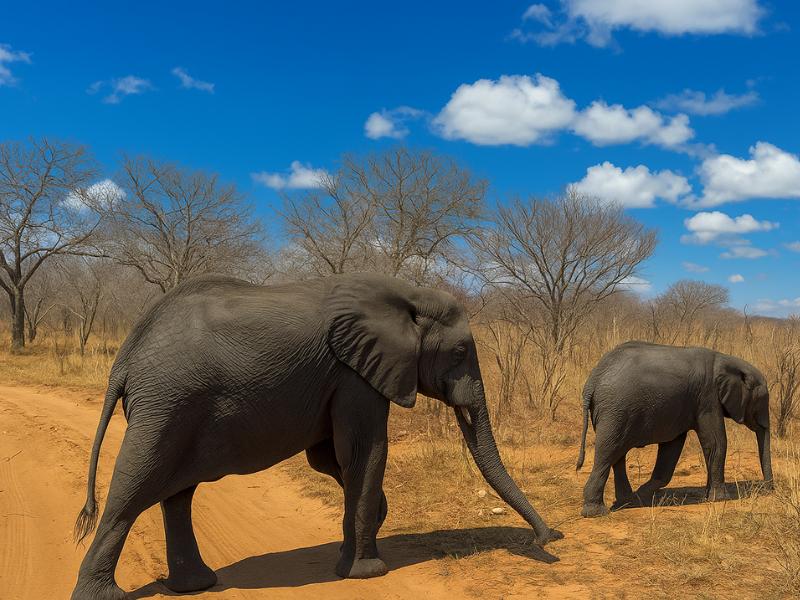
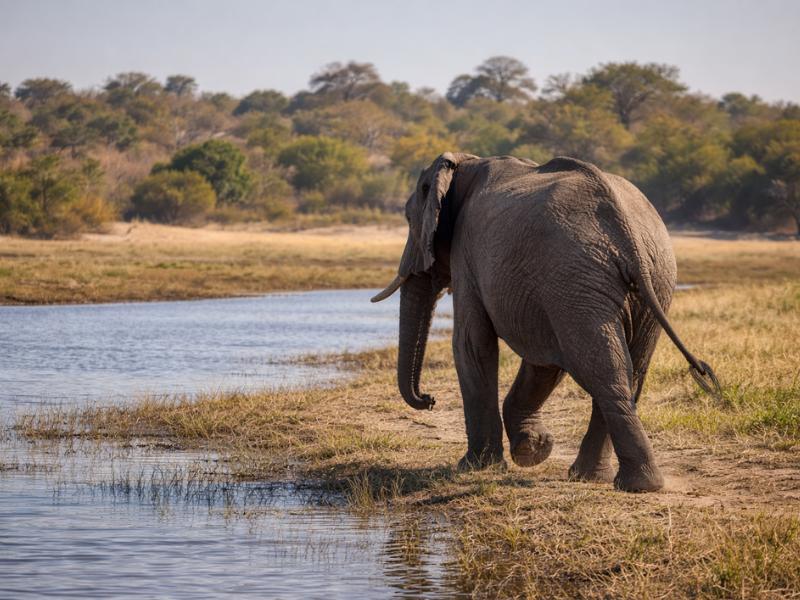
Population size in Chobe National Park exceeds 50,000 individuals creating the world’s largest and densest elephant concentration, with some estimates suggesting 60,000+ when including trans-boundary populations moving between Botswana and neighboring countries. The massive numbers translate to spectacular daily encounters with herds of 100-400 elephants gathering at the Chobe River during dry season afternoon sessions, creating wildlife spectacles unmatched anywhere on Earth. Individual elephants can be identified by ear patterns, tusk size and shape, and body characteristics, with some mature bulls becoming familiar to guides who observe them year after year.
Why so many elephants concentrate in Chobe stems from multiple interconnected factors. The permanent Chobe River provides year-round water surviving droughts that devastate temporary pans across surrounding Kalahari landscapes, making Chobe critical dry season refuge for elephants from hundreds of kilometers away. Trans-boundary populations move freely between Botswana, Namibia, Zimbabwe, and Zambia following ancient migration routes, with Chobe serving as hub in larger Kavango-Zambezi Transfrontier Conservation Area connecting five countries and supporting natural seasonal movements.
Effective anti-poaching protection in Botswana has allowed elephant populations to recover from historical hunting pressures, with Botswana’s shoot-to-kill anti-poaching policy and well-funded ranger programs providing security other African countries struggle to match. The stable political environment, tourism revenue funding conservation, and cultural respect for wildlife create conditions where elephants thrive rather than merely survive. Abundant mopane woodland provides quality browse, floodplain grasslands offer seasonal grazing, and overall habitat quality supports healthy breeding populations producing sustainable growth.
Herd dynamics follow complex social structures centered on matriarchal family groups of 8-20 related females and their offspring led by experienced older cows. The matriarch’s knowledge of water sources, feeding areas, and safe routes proves critical for family survival, with decades of accumulated experience guiding younger generations. Family bonds remain strong throughout life with sisters, aunts, and cousins maintaining close relationships, cooperatively raising young, and defending against threats together.
Bachelor groups of adolescent and young adult males form after leaving family units around age 12-15, traveling together in loose associations of 5-20 individuals learning adult male behaviors and sparring to establish dominance hierarchies. Mature bulls over 25-30 years increasingly become solitary, traveling alone or with one or two companions, joining breeding herds only for mating opportunities. The dominant bulls reaching 50-60 years old and weighing 5-6 tons command respect from younger males, though aggression remains rare with most interactions resolved through size displays and posturing.
Daily patterns during dry season follow predictable rhythms with elephants feeding in interior mopane woodlands overnight and early morning, then moving toward the Chobe River by mid-afternoon for drinking sessions. Morning game drives encounter elephants still feeding in woodland 5-10km from the river, browsing mopane leaves and bark, with family groups showing relaxed behaviors. By 3-4pm, elephant movement toward the river intensifies with herds converging from multiple directions creating dust clouds visible kilometers away.
The spectacular afternoon gatherings occur 4-6pm when 200-400 elephants arrive simultaneously at riverfront drinking areas, with some exceptional days seeing 500+ animals along 10-15km stretches. The congregations include multiple family groups, bachelor herds, and solitary bulls all tolerating close proximity during drinking, bathing, and playing in water. Elephants drink 150-300 liters daily depending on size and conditions, with drinking sessions lasting 30-60 minutes before groups disperse back to interior feeding areas for overnight browsing.
Breeding and calves occur year-round without specific seasons, though conception rates increase during wet months when abundant food supports pregnancy and lactation. The 22-month gestation period, longest of any mammal, means calves conceived during wet season appear following dry season with slightly higher numbers born May-October visible during prime safari months. Newborns weigh 90-120kg and stand wobbly within hours, staying close to mothers who nurse for 2-3 years though calves begin eating vegetation at 6-12 months.
Family groups provide communal care with aunts, sisters, and older siblings helping protect and guide young calves, teaching essential skills like drinking techniques, dust bathing purposes, and recognizing dangers. The protected youngsters play energetically, practicing behaviors they’ll need as adults including trunk control (initially floppy and uncoordinated), sparring with peers, and social interactions. Mortality rates are high with 50% of calves not surviving to age 5 due to predation by lions, diseases, drought stress, and accidents, though those reaching adulthood typically live 60-70 years.
A safari in September several years ago encountered a gathering we initially estimated at 200 elephants along a 2km riverfront stretch, but as we positioned the boat and counted systematically, the numbers kept increasing. Family groups emerged from woodland continuously between 4-5pm, converging on drinking areas until the entire visible shoreline disappeared under gray bodies. Our final count exceeded 380 elephants with countless more partially visible behind vegetation, creating an overwhelming sensory experience of trumpeting, rumbling communications, splashing, and dust clouds. Young calves played in shallows while mothers drank deeply, bachelor groups sparred on beaches, and massive bulls approached cautiously assessing social dynamics before joining. The guests sat speechless watching the spectacle unfold for over an hour as the light turned golden and elephants continued arriving, none of us having imagined such numbers were possible until witnessing it firsthand.
Recommended tours by season
Full-Day Chobe Safari via Kazungula Bridge
A full day from Victoria Falls via the Kazungula Bridge. Suited to the May–October dry months, when animals drink along the Chobe riverfront.
Chobe National Park Tour: Full Day with River Cruise
Full day from Livingstone with a river cruise and a game drive. The boat is how most visitors see hippos and crocodiles.
Chobe National Park: Overnight Trip with Night Drive, Village & Camping
A 24-hour trip with a night drive, a village visit, and camping. Use this if a single day is not enough time in the park.
Complete Botswana: National Parks & Delta Wildlife Safari
Seven days across Botswana’s national parks and the Okavango Delta. A better fit when you want more than the Chobe riverfront.
Lions: Chobe’s Apex Predators
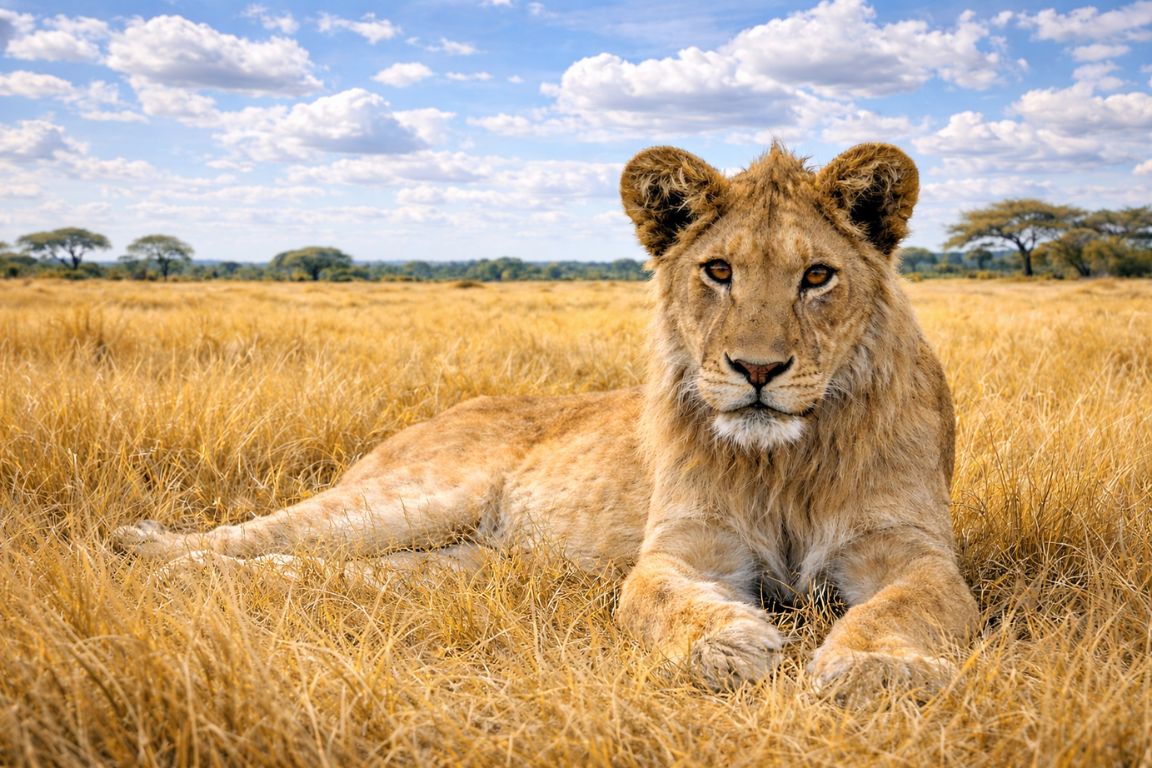 Population and pride structure in Chobe includes multiple resident prides ranging from 5-15 individuals each, with concentrations along the riverfront where prey densities support stable territories. The prides consist primarily of related females who remain together for life, their dependent cubs and adolescents, and one or more resident males controlling breeding access. Pride size fluctuates seasonally and annually based on prey availability, cub survival, and male takeover events that can fragment established groups.
Riverfront prides maintain smaller territories of 20-40 square kilometers due to concentrated prey, while interior Savuti and woodland prides range across 100-200 square kilometers following dispersed buffalo and antelope herds. The territorial boundaries shift over time as pride strength changes, with weaker prides losing ground to more powerful neighbors and nomadic coalitions probing for takeover opportunities. Total Chobe lion population estimates vary from 200-400 individuals depending on methodology and seasonal movements, representing healthy breeding populations across the 11,000 square kilometer protected area.
Hunting behavior centers on cooperative ambush tactics with lionesses coordinating approaches to prey, cutting off escape routes, and targeting vulnerable individuals from herds. Riverfront prides stake out waterhole ambush positions during dry season knowing buffalo, kudu, and other prey must visit daily for drinking, with lions concealing themselves in dense vegetation 20-50 meters from water’s edge waiting patiently for opportunities. The ambush success rates reach 20-30% when prey comes within striking distance, though many hunts fail when alert animals detect lions before attacks launch.
Cooperative hunting improves success significantly compared to solitary attempts, with 2-3 lionesses working together achieving 25-30% kills versus 15-20% for single hunters. The coordinated attacks involve flanking movements, one lioness driving prey toward concealed pride members, and rapid acceleration over final 20-30 meters closing distance before prey reaches full running speed. Buffalo represent preferred prey due to large size feeding entire prides for 2-3 days, though dangers from 700kg animals with sharp horns defending themselves create risks where lions occasionally suffer serious injuries or death.
Best viewing times for lions occur early morning 6-8am when prides remain at or near overnight kill sites, resting after feeding and too satiated to move far. Morning game drives finding fresh kills often observe entire prides gorging on carcasses, with dominant individuals feeding first while subordinates wait their turn, and scavengers like hyenas and vultures gathering nearby. The post-hunt period shows lions at their most relaxed and visible, lying in open areas too full to seek shade, providing excellent photographic opportunities.
Late afternoon 3-5pm viewing improves as lions wake from midday rest in dense shade, beginning to move and becoming active before evening hunts. The lions yawn extensively showing impressive canines, stretch elaborately, greet pride members with head rubbing and social interactions, and gradually transition from sleepy to alert hunting mode. Sunset viewing captures lions silhouetted against dramatic skies as they position near waterholes or move toward areas where prey concentrate for evening grazing.
We’ve got the game drive experience explained in Chobe tours based on what really happens – not just the glossy brochure version.
Where to find lions in Chobe centers on riverfront zones where concentrated prey during dry season creates reliable hunting grounds and highest sighting probabilities. The open areas between river and woodland edge provide ambush cover while allowing observation of approaching prey, with specific waterholes becoming known lion territories over successive seasons. Morning game drives along riverfront tracks between Kasane and Ngoma Gate encounter lions regularly at 60-80% probability on multi-day safaris during dry season May-October.
Savuti marsh area 180km southwest of riverfront supports different lion populations adapted to seasonal marsh conditions, with prides specializing in buffalo hunting on open grasslands. The Savuti lions gained fame for elephant hunting documented in wildlife films, though such behavior remains exceptional rather than routine. Interior mopane woodland throughout the park harbors nomadic males and smaller prides following antelope and giraffe, though thick vegetation makes finding lions more challenging than open riverfront country.
Male coalitions of 2-4 related brothers or unrelated partners team up to challenge resident pride males, with coalition strength determining ability to control territories and breeding access. Single males rarely hold prides successfully against coalition challenges, making partnership essential for reproductive success. The takeover battles involve fierce fighting with serious injuries common and occasional fatalities, particularly when resident males are aging and coalition challengers are in prime 5-8 year condition.
Successful takeovers result in new males killing existing cubs to bring females into estrus faster, eliminating previous males’ genetic legacy and ensuring their own offspring receive care. The infanticide triggers intense female defense attempts, though lionesses rarely succeed protecting cubs against determined coalition males. Territory control typically lasts 2-4 years before aging residents succumb to younger challengers, creating turnover ensuring genetic diversity across populations.
Cubs and breeding follow year-round patterns without specific seasons, with females giving birth to 2-4 cubs after 110-day gestation periods in dense vegetation away from pride. The newborns remain hidden for 6-8 weeks before mothers introduce them to pride members, reducing vulnerability to male infanticide and predation from hyenas or leopards. Communal care within prides allows females to share nursing duties, protect cubs cooperatively, and continue hunting while others babysit, improving overall cub survival compared to solitary maternal care.
Cub mortality remains extremely high with 60-80% not surviving to independence at 18-24 months, with causes including starvation during prey scarcity, male infanticide during pride takeovers, predation by hyenas, disease, and abandonment when prides move and young cubs cannot keep pace. The survivors reaching adulthood around 3-4 years face different futures depending on sex, with young females typically remaining in natal prides while young males are evicted around 2-3 years to form bachelor coalitions seeking their own territories.
Leopards: The Elusive Spotted Cats
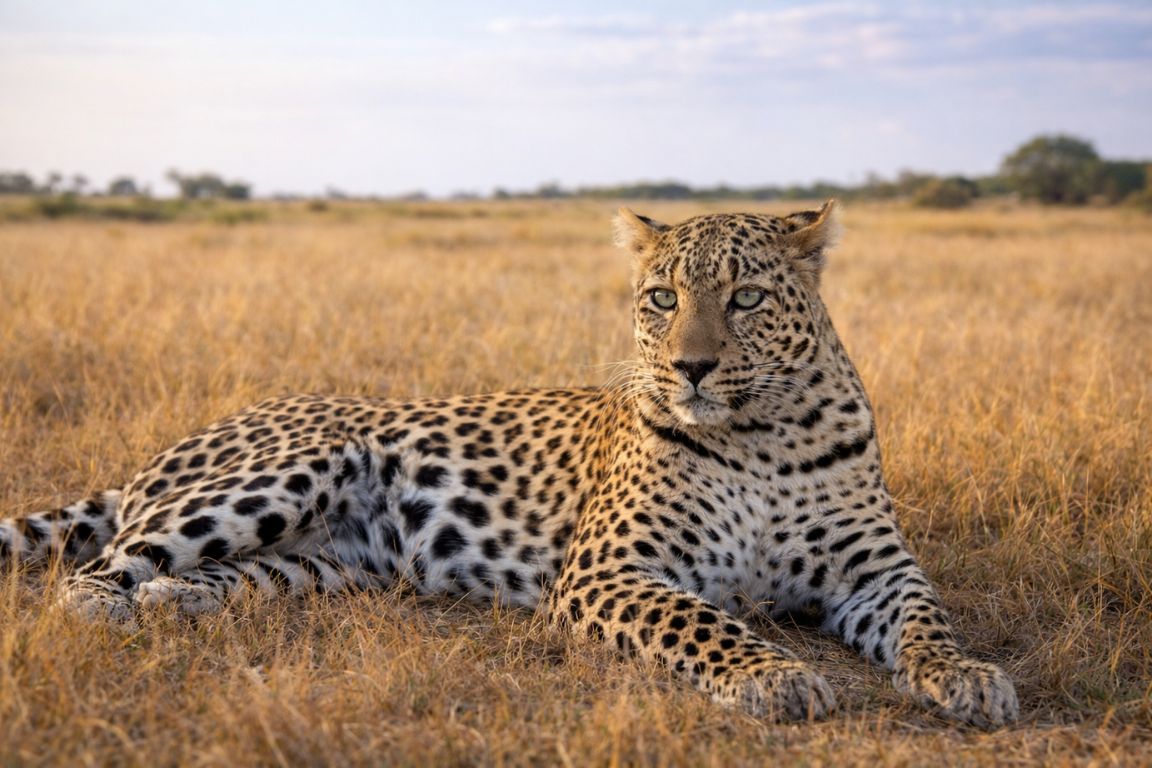
Why they’re hard to see starts with leopards being strictly solitary cats that avoid other leopards except during brief mating periods, meaning encounters with multiple individuals never occur and single sightings represent the only possibility. The largely nocturnal behavior means leopards conduct most hunting and territorial activities during darkness when safari vehicles aren’t operating, with daylight hours spent resting hidden in dense vegetation or high in trees. Excellent camouflage through spotted coat patterns perfectly matching dappled light and shadow in woodland environments makes stationary leopards virtually invisible even at 10-20 meters distance, with many passing undetected despite being present.
The secretive nature and instinctive freeze response when detecting humans means leopards often remain motionless allowing vehicles to pass without occupants realizing cats are watching from thick bush 15 meters away. Low population density with large territories means fewer individual leopards occupy Chobe compared to numerous lions or elephants, reducing statistical encounter probability. The combination of solitary habits, nocturnal activity peaks, superb camouflage, and low density creates 25-40% sighting odds on multi-day safaris versus 70-80% for lions, making leopard encounters among safari’s most prized experiences.
Typical habitats leopards favor include dense riverine thickets along Chobe River featuring jackalberry, sausage trees, and tangled understory vegetation providing concealment for stalking prey and resting during heat. The riverfront woodland offers abundant prey including impala, bushbuck, and water monitors, plus mature trees for caching kills away from scavenging hyenas and lions. Interior mopane woodland with thick canopy and ground-level vegetation supports leopards hunting kudu and duiker, though sparser tree distribution compared to riverfront makes tree-caching more challenging.
Rocky outcrops and kopjes where they exist provide den sites for raising cubs, territorial scent-marking posts, and elevated vantage points surveying hunting grounds, though Chobe’s generally flat terrain limits this habitat type. Leopards avoid completely open floodplains lacking cover for stalking, preferring edge habitats where woodland meets grassland allowing ambush opportunities as prey moves between vegetation and open grazing areas. The habitat preferences mean leopard searches focus on dense riverine sections, woodland edges, and areas with mature trees suitable for daytime resting.
Best viewing times for leopards occur during crepuscular periods at dawn 5:30-7am and dusk 5-6:30pm when cats transition between nocturnal hunting and daytime resting, becoming briefly active and visible. Early morning game drives departing 6am occasionally encounter leopards still hunting or walking territorial boundaries before seeking daytime rest sites, with cats more visible in open areas during low-light periods before retreating to dense cover. Late afternoon drives capture leopards emerging from daytime rest around 5-5:30pm, stretching, grooming, and beginning to move toward hunting grounds as light fades.
Midday viewing opportunities exist when leopards rest in trees during hot hours, with patient scanning of large horizontal branches 4-8 meters above ground sometimes revealing spotted forms draped over limbs with legs dangling. The tree-resting behavior makes leopards more visible than if concealed in ground-level thickets, though spotting them requires systematic searching of suitable trees in known leopard territories. Alarm calls from prey species including impala snorts, baboon barks, and francolin calls often alert guides to leopard presence nearby, warranting careful investigation of dense vegetation where cats might be moving or stalking.
Hunting behavior relies entirely on stalking and ambush tactics with leopards approaching prey using available cover, freezing when animals look up, and closing final 10-20 meters in explosive rush before prey can accelerate to full escape speed. The solitary hunting without cooperative pride members means leopards target smaller prey than lions, focusing on impala, bushbuck, duiker, warthog, and young antelope in 20-60kg range they can kill and carry alone. Larger prey like adult kudu occasionally get targeted, though risks from animals outweighing leopards by 3-4 times create dangers from defensive horns and powerful kicks.
Tree caching of kills proves essential for protecting hard-won food from scavenging lions and hyenas that would steal carcasses within hours if left on the ground. Leopards drag kills weighing 40-80kg vertically up trees 4-8 meters using incredible strength, wedging carcasses in branch forks where they can feed over 2-3 days while resting nearby. The cached kills provide multiple feeding opportunities without requiring new hunts daily, conserving energy and reducing injury risks from repeated hunting attempts. Failed hunts far outnumber successes with 85-90% of attempts ending without captures, making efficient use of successful kills critical for survival.
Territory size ranges from 15-30 square kilometers for females in prey-rich riverfront areas to 40-80 square kilometers for males whose territories overlap multiple female ranges, ensuring mating access to several partners. The solitary lifestyle means leopards maintain territories individually through scent marking with urine, feces, and claw scraping on trees, plus occasional confrontations with intruding neighbors, though serious fights rarely occur as scent boundaries usually prevent encounters. Males patrol extensive territories requiring several days to cover full range, while females with dependent cubs restrict movements to smaller core areas around den sites.
Territorial stability means individual leopards occupy the same general areas for years, with experienced guides learning which riverfront sections, woodland patches, or specific trees host resident leopards increasing finding odds through local knowledge. The large territories and solitary nature mean leopard sightings involve same individual on successive days rather than different cats, though transient nomadic leopards without established territories occasionally appear in areas between resident ranges. Solitary lifestyle is broken only during 5-7 day mating periods when males and females tolerate close proximity, and when females raise cubs for 12-18 months before offspring disperse to establish their own territories.
Other Predators and Scavengers
Wild dogs roam Chobe in packs of 8-15 individuals representing critically endangered species with only 6,000-7,000 remaining across Africa. The packs maintain complex social structures led by alpha breeding pairs, with all pack members cooperatively raising pups and sharing food through regurgitation after successful hunts. The painted dogs hunt using stamina-based pursuit rather than ambush tactics, chasing prey at sustained 40-50 km/h speeds for several kilometers until exhaustion allows killing, achieving 80% hunt success rates far exceeding lion or leopard efficiency.
Sighting odds remain low at 10-20% on multi-day safaris as packs range widely across territories exceeding 400-800 square kilometers, moving constantly in search of prey and rarely staying in areas longer than 2-3 days. Denning periods April-September when pups are too young to travel restrict pack movements to smaller areas around den sites, marginally improving encounter odds during these months. The distinctive tricolored coats with unique patterns on each individual, large rounded ears, and enthusiastic greeting ceremonies make wild dog sightings among safari’s most memorable despite rarity.
Cheetahs appear uncommonly in Chobe with 5-15% sighting probability as the park’s habitat doesn’t ideally suit these open-plains specialists. The primarily woodland and riverine environment with limited extensive short-grass plains restricts cheetah hunting success, as these cats rely on open terrain allowing acceleration to 100+ km/h sprint speeds catching prey through pure velocity. Occasional sightings occur on Chobe’s floodplain grasslands where habitat resembles preferred Serengeti-type environments, with solitary males or mother-cub groups hunting impala and smaller antelope.
The slender build, solid spot patterns (versus leopard rosettes), distinctive black tear marks from eyes to mouth, and diurnal hunting during cooler morning hours distinguish cheetahs from larger more powerful leopards. Competition from lions and spotted hyenas further limits cheetah success in Chobe, as these stronger predators steal cheetah kills and occasionally kill cheetahs themselves, making Chobe marginal habitat for species thriving better in East African grasslands.
Spotted hyenas live in matriarchal clans of 10-40 individuals with females larger and dominant over males, contrary to popular perception of hyenas as purely scavenging cowards. Chobe’s hyena clans actively hunt 60-70% of their food, using cooperative pack tactics similar to wild dogs but with bone-crushing jaws delivering killing bites rather than exhaustion-based kills. The powerful jaws exert 1,100 PSI bite force capable of cracking large bones and consuming entire carcasses including hooves and horns, eliminating waste and explaining the calcium-rich white droppings marking clan territories.
Clan territories center on communal dens where females raise cubs cooperatively, with strict dominance hierarchies determining feeding order at kills and breeding access for males. The misunderstood reputation stems from scavenging behavior at lion kills, distinctive laughing calls during excitement, and generally unattractive appearance with sloping backs and coarse fur, though ecological roles as both hunters and bone-recycling scavengers prove essential for ecosystem health. Night drives in private concessions reveal hyena activity peaks during darkness when most hunting occurs, explaining why daytime game drives miss the majority of hyena predatory behavior.
Side-striped jackals represent Chobe’s smaller canid predators at 7-12kg, appearing occasionally during game drives as opportunistic omnivores feeding on insects, small mammals, birds, fruit, and scavenging from large predator kills. The distinctive dark stripe bordered by light stripes along flanks identifies them from similar black-backed jackals, with side-striped preferring woodland habitats versus open grasslands. Primarily nocturnal activity means sightings occur most often during early morning or late evening drives as jackals return to or emerge from daytime resting sites in dense vegetation.
The monogamous pairs maintain small territories defended year-round, with both parents raising 3-6 pups in underground dens during September-December breeding season. The adaptable diet and ability to survive in various habitats from riverfront through woodland to agricultural edges makes side-striped jackals successful despite relatively low densities, filling ecological niche as small-to-medium prey hunters and secondary scavengers cleaning remains large predators leave behind.
Honey badgers possess fearless reputations justified by aggressive defense against threats regardless of size, attacking lions, buffalo, and even elephants when cornered or protecting young. The stocky muscular build, powerful claws for digging, and thick loose skin protecting from bites and stings allow honey badgers to raid bee hives (hence the name), hunt venomous snakes, and excavate burrowing prey that other predators cannot access. Primarily nocturnal habits make sightings rare despite widespread distribution, with lucky encounters during dawn or dusk drives providing memorable experiences watching these 9-16kg carnivores fearlessly going about their business.
The striking appearance with white or gray back contrasting against black underside, fierce temperament, and reputation for tenacity make honey badger sightings highly prized by guides and guests despite brief nature of most encounters as animals move purposefully through territories. The varied diet including honey, small mammals, birds, reptiles, insects, and occasional scavenging demonstrates remarkable adaptability allowing survival across diverse African habitats.
Servals and caracals represent Chobe’s small cat species rarely seen due to predominantly nocturnal habits, solitary nature, and preference for dense vegetation providing concealment. Servals with golden coats heavily spotted with black markings, exceptionally large ears, and long legs hunt in tall grasslands and reed beds, specializing in rodent prey caught through spectacular vertical leaps locating prey by sound. Caracals feature uniform tan coats, distinctive long black ear tufts, and powerful builds allowing them to take prey up to small antelope size, though more typically hunting birds, rodents, and hares.
Both species maintain sighting odds under 10% even on week-long safaris, with encounters typically brief glimpses during dawn drives as cats return to daytime resting cover or dusk sightings as they emerge to hunt. The elusive nature and beautiful appearance make any serval or caracal sighting exceptional luck, representing bonus rare species that serious wildlife enthusiasts pursue but casual visitors shouldn’t expect to encounter.
Raptors dominate aerial predation with African fish eagles as Chobe’s most iconic bird of prey, perching prominently in riverside trees watching for fish near surface then swooping to snatch prey with powerful talons. The distinctive yelping call echoing across water and white head/chest contrasting with brown body makes fish eagles instantly recognizable and commonly seen on boat cruises at 85-95% probability. Multiple vulture species including white-backed, hooded, and lappet-faced vultures soar high using thermals to locate carcasses, with 20-40 birds descending within minutes when large predator kills are found.
Martial eagles representing Africa’s largest eagles at 6kg hunt from great heights stooping on prey including small antelope, game birds, and monitor lizards, though sightings remain uncommon at 15-25% odds on multi-day safaris. Bateleur eagles with distinctive rocking flight pattern and black-red-white plumage patrol woodlands hunting snakes, birds, and small mammals. The diverse raptor community from tiny pygmy falcons through massive martial eagles demonstrates predation occurring across all size classes from insects through medium mammals, with each species occupying specific hunting niche.
Buffalo: The Dangerous Herbivores
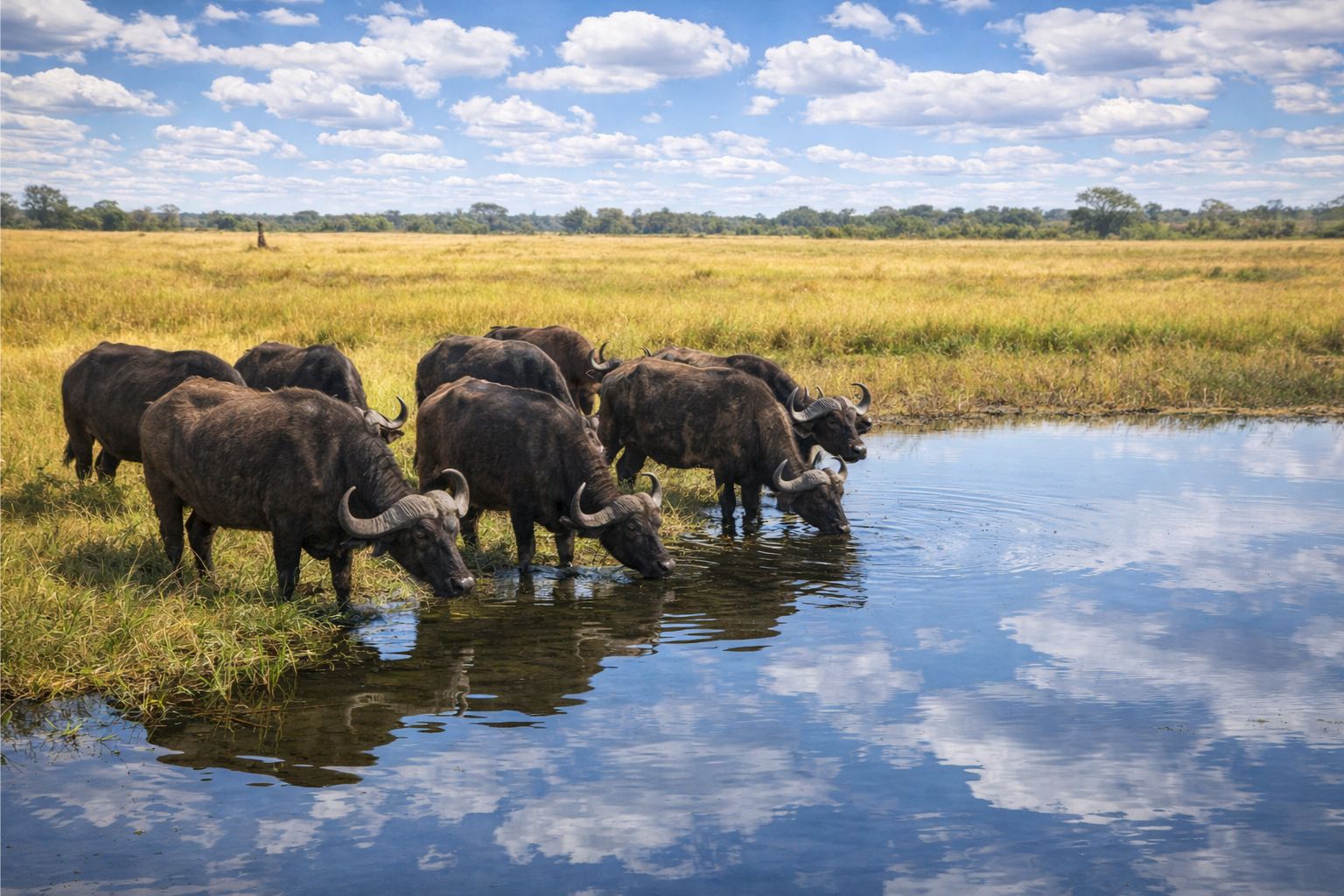 Herd sizes in Chobe range from small bachelor groups of 10-30 bulls through breeding herds of 100-500 animals to massive dry season aggregations exceeding 1,000-2,000 buffalo gathering on floodplains near the Chobe River. The spectacular concentrations occur May-October when water scarcity forces buffalo to remain near permanent water, with multiple separate herds converging on prime grazing areas creating black masses of animals stretching across grasslands. Single sightings during dry season regularly involve 300-800 buffalo, with exceptional days encountering 1,500+ animals as dust clouds from their movements become visible kilometers away.
Wet season disperses herds widely as seasonal water pans allow buffalo to range across the entire park accessing scattered grazing and water sources. The breeding herds fragment into smaller units of 50-150 animals spreading throughout available habitat, reducing competition for resources and making wet season buffalo sightings involve much smaller groups than dry season’s massive aggregations. The herd size fluctuations create dramatically different viewing experiences depending on season, with dry season delivering the spectacular numbers Chobe is known for.
Daily patterns follow predictable rhythms during dry season with buffalo grazing open floodplains during cooler morning hours 6-9am and late afternoon 3-6pm, chewing cud and resting during hot midday 10am-3pm in sparse shade or near water, and drinking at the Chobe River typically late morning and mid-afternoon. The grazing herds move steadily across grasslands consuming vast quantities of grass, with adult bulls eating 20-30kg daily and entire herds of 500 animals consuming 10-15 tons collectively. Morning game drives encounter buffalo actively feeding with heads down systematically grazing, while afternoon drives find herds moving toward water or gathered at riverfront drinking areas.
Midday drinking sessions create spectacular sights as hundreds of buffalo crowd riverbanks, with orderly queues forming as animals wait turns at water’s edge, drink deeply for several minutes, then move aside allowing others access. The vulnerable drinking moments attract predator attention with lions positioning in ambush nearby, though buffalo’s size and herd vigilance make successful hunts challenging requiring coordinated pride efforts targeting calves or weakened individuals.
Herd structure shows clear social organization with breeding herds comprising adult females, their calves and juveniles, and young adult males up to 5-7 years old led by dominant matriarchs. The breeding herds maintain stable membership with females remaining together for life, raising young cooperatively, and defending against predators through group vigilance and coordinated charges driving lions away. Synchronized breeding during wet season November-February means calves appear together in large cohorts during dry season, creating nursery groups where multiple calves play together under collective maternal supervision.
Bachelor groups of adult males form separate social units of 10-50 bulls traveling together, grazing cooperatively, and competing through sparring to establish dominance hierarchies without serious fighting. The bachelor herds show looser organization than breeding herds, with membership fluid as bulls come and go between different groups. Old bulls beyond prime breeding age increasingly become solitary, leaving bachelor groups to live alone or with one or two companions, spending days wallowing in mud which dries to gray coating giving “dagga boy” nickname to these crusty old veterans.
Seasonal movements show dramatic concentration shifts with wet season November-April dispersing buffalo widely across the park and into neighboring countries as temporary water and fresh grazing becomes available everywhere. The herds fragment and range freely without water constraints, with some populations moving 50-100km from dry season riverfront territories into interior mopane and remote areas. Dry season May-October forces progressive concentration along the Chobe River floodplains as temporary water sources dry up, with buffalo commuting increasingly long distances between diminishing grazing areas and permanent water creating predictable daily movements along established routes.
Size and characteristics make buffalo among Africa’s most physically impressive herbivores with adult bulls weighing 700-900kg and standing 1.5-1.7 meters at shoulder, while cows average 500-700kg and stand 1.3-1.5 meters. The massive boss (horn base) on mature bulls forms solid bone shield across forehead, with thick curved horns sweeping down, out, then up in distinctive shape spanning 1 meter across. The solid black coloration occasionally shows reddish tones on younger animals, massive stocky build, and generally serious demeanor create formidable presence. The combination of size, weaponry, unpredictable temperament, and herd protection makes buffalo one of the most dangerous animals to encounter despite herbivorous diet.
Giraffes and Zebras
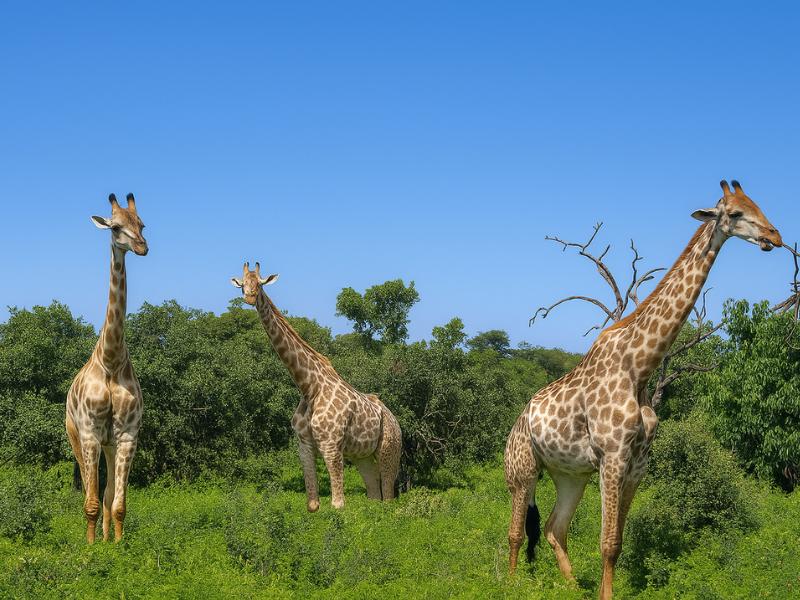
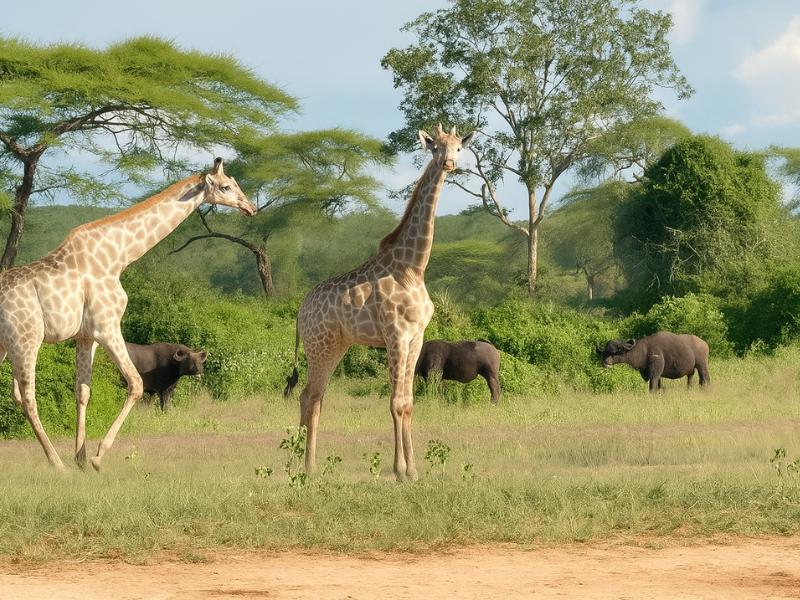
Population in Chobe shows moderate giraffe numbers concentrated in woodland areas where acacias and other trees provide browse at 4-6 meter heights only giraffes can access. The populations don’t reach densities seen in some East African parks but remain healthy and widespread throughout Chobe’s interior mopane and mixed woodland zones. Sighting odds reach 60-80% on multi-day safaris as game drives through woodland habitat regularly encounter giraffes browsing tree canopies, their height making them visible from great distances across relatively flat terrain. Two-day safaris show 60-70% giraffe probability, while 3-4 day trips increase odds to 70-80% through coverage of varied woodland sectors where giraffes feed.
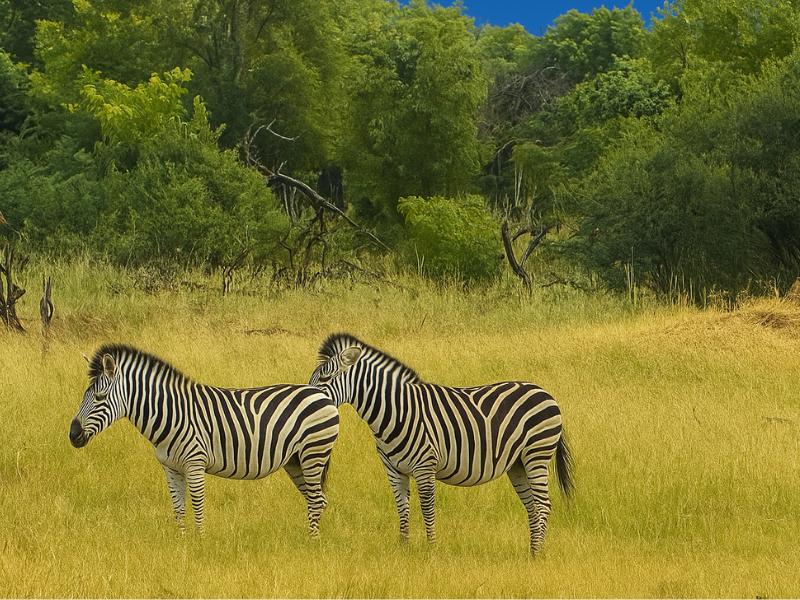
Zebra patterns in Chobe involve plains zebra, the most widespread zebra species featuring bold black and white vertical stripes extending down legs and onto belly. The populations remain smaller than East African parks like Serengeti or Masai Mara where hundreds of thousands migrate seasonally, with Chobe supporting modest resident populations of several thousand individuals scattered across suitable grassland and woodland edge habitats. The smaller numbers mean zebra sightings involve groups of 10-50 animals rather than massive herds, though encounters remain regular during dry season when zebras concentrate near water alongside other herbivores.
Social structure for both species shows distinct patterns with giraffe bachelor groups of 4-12 young adult males traveling together in loose associations, while family units of 3-8 individuals include adult females with offspring browsing together under casual leadership without strict hierarchy. Zebra organization proves more structured with family units of 5-15 animals led by dominant stallions controlling harems of mares and their foals, defending against rival males attempting to steal females. Bachelor groups of young zebra stallions not yet controlling territories travel together in bands of 8-20 individuals, sparring to establish dominance rankings and practicing behaviors needed for future territory acquisition.
Seasonal visibility improves dramatically during dry season May-October as sparse vegetation and dried grass make spotting both species easier across open woodland and grassland habitats. Giraffes browsing tree canopies remain visible through thinned foliage where wet season dense leaf cover would obscure them, zebras grazing short dry grass stand out clearly against brown backgrounds versus blending into lush green wet season vegetation. The dry season concentration near water also brings both species into more accessible areas along riverfront and floodplains where game drive routes focus, improving encounter odds beyond just visibility improvements from sparse vegetation.
Antelopes and Other Herbivores
Impala represent Chobe’s most abundant antelope species with populations numbering tens of thousands creating 99% sighting guarantees even on single-day trips. The medium-sized graceful antelope weighing 40-60kg feature reddish-brown coats with distinctive black stripes on rumps and tails, with males carrying elegant lyre-shaped horns reaching 50-90cm. Herds of 20-100 animals graze open woodlands and grassland edges throughout the park, with breeding herds of females and young led by territorial males during rutting season, and bachelor groups of young males traveling together outside breeding periods.
The ubiquitous presence across virtually all habitats from riverfront through woodland to floodplain edges makes impala constant companions on game drives, with their abundance sometimes causing visitors to overlook them despite attractive appearance and entertaining behaviors including spectacular leaps clearing 3 meters high and 10 meters distance when alarmed. The sharp alarm snorts when detecting predators often alert safari vehicles to nearby lions or leopards, making impala valuable sentinel species indicating predator presence through distinctive warning vocalizations.
Kudu showcase greater kudu as one of Africa’s most impressive antelope with bulls carrying magnificent spiral horns reaching 1.2 meters length through 2-3 graceful twists, weighing 190-270kg and standing 1.4-1.6 meters at shoulder. The gray-brown coats feature 6-10 vertical white stripes down sides, distinctive white chevron between eyes, and large rounded ears providing excellent hearing in dense vegetation where kudu typically dwell. Sighting probability reaches 70-90% on multi-day safaris as kudu occupy woodland edges, riverine thickets, and mopane forests throughout Chobe, browsing leaves and shoots at 1-2 meter heights.
Kudu remain alert and shy compared to impala, often freezing motionless when detecting vehicles before melting into vegetation or bounding away with characteristic high jumps clearing obstacles. Bulls travel singly or in small bachelor groups of 2-5 individuals, while cows form herds of 5-15 with offspring, joining temporarily with bulls during breeding season. The impressive horns and cryptic behavior make kudu sightings particularly satisfying despite relatively common occurrence.
Waterbuck feature large sturdy antelope weighing 200-300kg staying exclusively near water sources, with distinctive shaggy gray-brown coats and prominent white ring circling rumps like painted toilet seats. Males carry thick ringed horns sweeping forward then upward reaching 70-90cm, while both sexes show the characteristic rump ring allowing easy identification even at distance. Sighting odds reach 60-80% on multi-day safaris as waterbuck occupy riverfront habitat, floodplain edges near water, and areas within 1-2km of permanent water never straying far from safety of rivers or marshes.
The water-dependence concentrates waterbuck along accessible game drive routes paralleling the Chobe River, improving encounter frequency compared to species ranging into remote interior areas. Small groups of 5-15 animals graze together with alert posture and tendency to flee toward water when threatened, sometimes entering shallows to escape terrestrial predators despite crocodile risks.
Sable and roan antelope represent large impressive species with sable bulls weighing 220-270kg featuring distinctive backward-curving horns reaching 1-1.2 meters, glossy black coats (bulls) or dark brown (cows), and striking white facial markings. Roan antelope at 240-300kg show red-brown coats, shorter backward-curving horns, and distinctive tufted ears. Both species occupy open woodland habitats preferring areas with medium grass heights, appearing less frequently than smaller antelope with combined sighting odds around 30-40% on multi-day safaris requiring exploration of interior woodland zones away from concentrated riverfront tourism.
The impressive size, beautiful horns, and relative scarcity make sable and roan sightings prized encounters, with small herds of 8-25 animals led by territorial bulls defending feeding areas. The preference for specific woodland savanna habitats means targeted searching in appropriate zones yields better results than expecting opportunistic roadside encounters.
Lechwe and puku comprise specialized water-dependent antelope rarely seen in main Chobe riverfront area but occurring in seasonal marsh habitats like Savuti where suitable wetland conditions exist. Lechwe at 80-100kg feature elongated hooves adapted for moving through shallow water, with males carrying lyre-shaped horns and golden-red coats. Puku at 60-80kg show stocky builds, golden-orange coats, and males with shorter straight horns, inhabiting floodplain edges and seasonal marshes. Combined sighting odds remain low at 15-25% even on extended safaris as limited suitable habitat restricts populations, making encounters with either species fortunate rather than expected.
Warthogs provide entertaining viewing as common residents across all Chobe habitats at 50-80kg, featuring characteristic upturned tusks, facial warts (skin growths), and comical behavior. The gray skin, sparse bristly hair, and distinctive tails held straight up like flags when running at 50 km/h make warthogs instantly recognizable. The amusing habit of kneeling on calloused front knees while grazing or rooting for underground tubers, family groups of mothers with 2-4 piglets trotting single-file, and tendency to reverse into burrows backwards for defense create memorable humorous moments contrasting with more serious wildlife encounters.
Bushbuck and duiker represent smaller shy antelope occupying dense vegetation where they remain largely hidden from casual observation. Bushbuck at 25-80kg (males significantly larger than females) show chestnut coats with white spots and stripes, preferring riverine thickets and dense woodland undergrowth where sighting odds reach just 20-30% despite reasonable populations. Common duiker at 15-25kg feature uniform gray-brown coloring, hunched posture, and habit of freezing motionless when alarmed before explosive flight into cover, occurring throughout but rarely seen due to secretive nature and dense habitat preference keeping them concealed from safari vehicles.
| Impala | 40-60kg | Reddish-brown, black stripes on rump/tail, lyre horns (males) | Open woodland, grassland edges, everywhere | 99% – guaranteed |
| Greater Kudu | 190-270kg | Spiral horns up to 1.2m (males), gray-brown with white stripes, large ears | Woodland edges, riverine thickets, mopane forest | 70-90% |
| Waterbuck | 200-300kg | Shaggy gray-brown coat, distinctive white rump ring, thick ringed horns (males) | Always near water, riverfront, floodplain edges | 60-80% |
| Sable Antelope | 220-270kg | Backward-curving horns 1-1.2m, black coat (bulls), white facial markings | Open woodland, medium grass savanna | 30-40% (combined sable/roan) |
| Roan Antelope | 240-300kg | Red-brown coat, shorter curved horns, tufted ears, large size | Open woodland savanna | 30-40% (combined sable/roan) |
| Lechwe | 80-100kg | Golden-red coat, elongated hooves, lyre horns (males), water specialist | Seasonal marshes (Savuti area) | 15-25% (combined lechwe/puku) |
| Puku | 60-80kg | Golden-orange coat, stocky build, straight horns (males), floodplains | Floodplain edges, seasonal marshes | 15-25% (combined lechwe/puku) |
| Bushbuck | 25-80kg | Chestnut coat with white spots/stripes, hunched posture, shy | Dense riverine thickets, undergrowth | 20-30% |
| Common Duiker | 15-25kg | Gray-brown, small size, hunched, freezes when alarmed | Dense vegetation throughout | 20-30% |
| Warthog | 50-80kg | Gray skin, upturned tusks, facial warts, tail up when running | All habitats, open areas, near burrows | 70-85% |
Hippos: River Giants
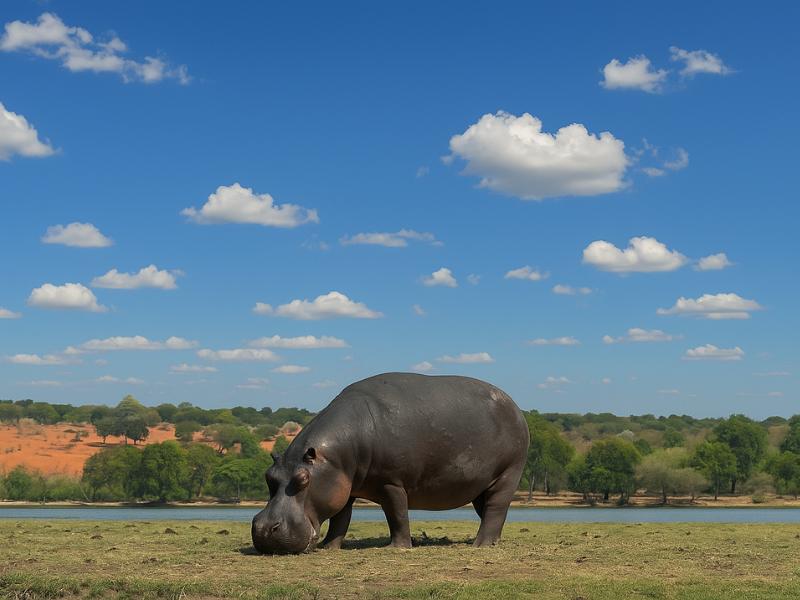
Population in Chobe River includes resident pods distributed throughout the entire 50km riverfront stretch from Kasane to Sedudu area, with individual pods ranging from 20-100 individuals depending on territory quality and available river depth. The total Chobe River hippo population reaches several thousand animals occupying every suitable section featuring adequate water depth during dry season low levels, calm current allowing wallowing without excessive energy expenditure, and sandbanks or shallow areas for emerging at night to graze. Each pod maintains defined river territory averaging 100-300 meters of shoreline defended by dominant bulls, with larger high-quality sections supporting 60-100 hippos while marginal areas host smaller groups of 20-40 animals.
Pod dynamics center on territorial bulls controlling river sections containing groups of cows and calves, with dominant males aggressively defending territories against rival bulls attempting takeovers or encroachment. The territorial bull tolerates subordinate males within his section provided they show submission and don’t challenge his breeding access to females, creating hierarchical structure where one alpha male fathers most calves while bachelor males occupy peripheral positions. Cows and calves form stable social units within territories, with females giving birth to single calves after 8-month gestation periods and nursing young underwater for 12-18 months before weaning.
The pod structure remains relatively stable across seasons with same territorial bulls maintaining control for months or years until aging or injury allows younger challengers to displace them. Females within territories show cooperative behaviors including communal protection of calves against threats, though serious maternal bonds exist only between individual mothers and their offspring. Subadult males reaching sexual maturity around 7-8 years get expelled from natal pods by territorial bulls, joining bachelor groups in marginal habitat or attempting to claim their own territories through challenging established bulls.
Territorial aggression between bulls involves spectacular violent confrontations as challengers attempt displacing territory holders, with massive jaws capable of 1,800 PSI bite force clashing in bloody battles. The fights occur primarily in water with bulls rearing up, mouths opened wide displaying 50cm canine teeth, then crashing together attempting to bite necks, flanks, or faces causing serious wounds. Yawning displays showing enormous gaping mouths exposing massive teeth serve as threat behaviors warning rivals and intruders, with the intimidating 150-degree jaw opening demonstrating weaponry available for combat.
The aggression makes hippos Africa’s most dangerous large animal to humans, responsible for estimated 500+ annual human deaths through attacks on boats, people at water’s edge, or encounters on land during nightly grazing excursions. The unpredictable nature means hippos can appear docile wallowing peacefully then attack without warning if feeling threatened, boats pass too close to pods, or people inadvertently position between hippos and water escape routes. The combination of massive size (1,500-3,000kg), speed up to 30 km/h in short bursts, aggressive territoriality, and powerful jaws makes hippos requiring constant respectful distance during safari viewing.
Best viewing occurs during boat cruises along the Chobe River providing water-level perspectives of hippos wallowing in shallows, yawning to display teeth, engaging in social interactions, and occasionally surfacing dramatically near boats. The 95-99% probability of seeing multiple pods on any boat cruise makes hippos among Chobe’s most reliably encountered species, with typical 2-3 hour cruises passing 3-8 different pods totaling 100-200+ individual hippos. The stable boat platforms allow excellent photography opportunities capturing yawning displays, social behaviors, mothers with calves, and territorial bulls patrolling boundaries.
Morning boat cruises 6-9am sometimes encounter hippos returning to water after overnight grazing on land, watching as animals walk down banks and submerge in familiar territories. Afternoon cruises 3-6pm show hippos most active with increased surface time, yawning displays, social interactions, and occasional movement between wallowing spots creating dynamic viewing. The water-based perspective reveals behaviors impossible to observe from land-based game drives, including underwater swimming with just eyes and nostrils visible, defecation displays (spinning tails spreading dung marking territory), and coordinated pod movements when disturbed.
We’ve broken down boat safari vs game drive in Chobe tours so you can figure out which matches your interests – or if your schedule allows for both experiences.
Crocodiles: Ancient River Predators
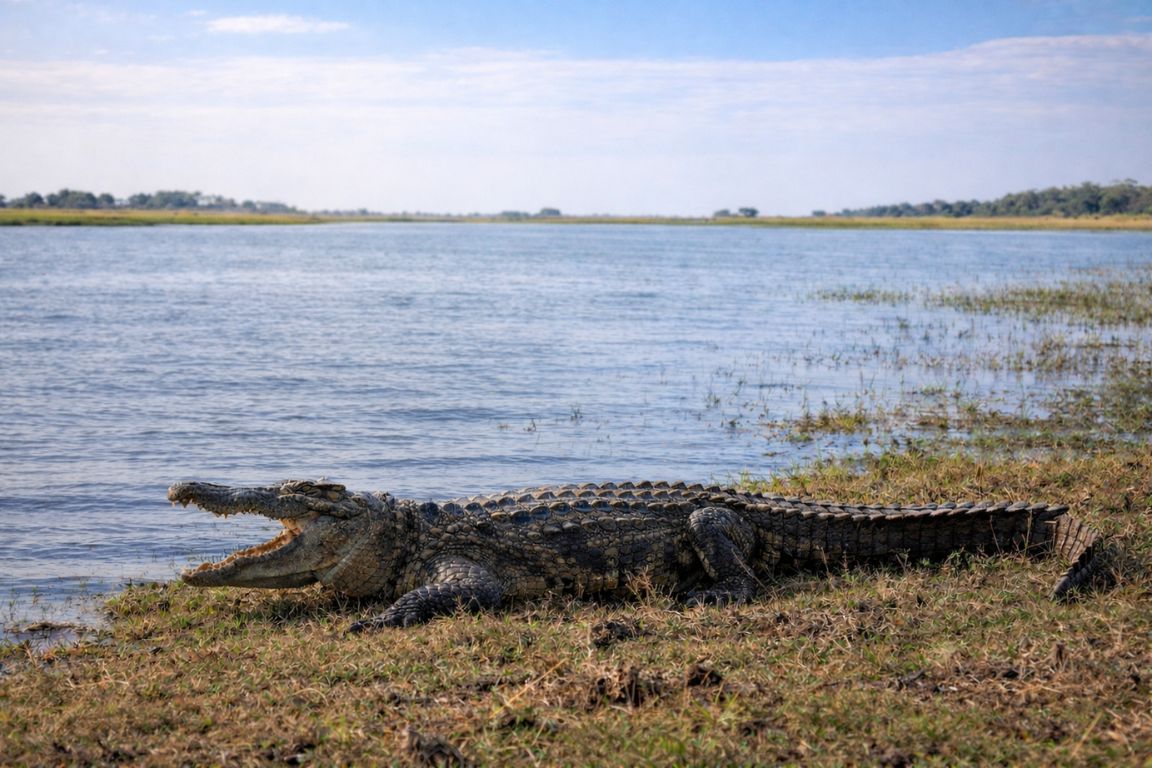 Nile crocodile size in Chobe River commonly ranges 3-5 meters for adult specimens, with exceptional individuals reaching 5-6 meters length and weighing 700-1,000kg. The largest crocodiles concentrate in areas with abundant prey and minimal disturbance, growing slowly over decades to reach massive proportions. Males grow larger than females, with 5+ meter individuals invariably being dominant territorial bulls commanding prime riverfront territories. Juveniles at 1-2 meters and sub-adults at 2-3 meters appear frequently alongside adults, representing healthy breeding populations producing successive generations.
Basking behavior serves essential thermoregulation as crocodiles, being cold-blooded reptiles, cannot generate internal body heat and must absorb warmth from external sources. Morning basking sessions starting 7-9am see crocodiles hauling out onto sandbanks, mudbanks, and rocks, positioning bodies perpendicular to sun rays maximizing surface area exposure. The characteristic mouths-open posture allows cooling through evaporation from mouth tissues, regulating temperature preventing overheating during midday heat when crocodiles have absorbed sufficient warmth. Afternoon basking continues until optimal body temperature around 30-33°C is achieved, then crocodiles retreat to water as temperatures exceed comfortable ranges.
Hunting tactics rely entirely on ambush predation with crocodiles positioning motionless at water’s edge, submerged with just eyes and nostrils visible, waiting for prey to approach for drinking. The explosive launch from concealment covers 3-5 meters in seconds, powerful jaws snapping shut on prey before victims can react or escape. The 3,700 PSI bite force (strongest measured of any animal) crushes bones and maintains grip on struggling prey, while death roll technique sees crocodiles spinning rapidly to disorient prey, tear off chunks of flesh, and drown terrestrial animals. Large prey gets cached underwater wedged under logs or rocks, softening for several days before feeding as crocodiles cannot chew and must tear off swallowable chunks.
Population density remains high along the entire Chobe River stretch with crocodiles occurring at intervals of every 200-500 meters during dry season when low water concentrates populations. Boat cruises routinely count 20-40 crocodiles during 2-3 hour outings, with multiple basking individuals visible simultaneously on popular sandbanks. The abundant prey including fish, water monitors, birds, and occasional mammals coming to drink supports healthy populations across all size classes. Territorial spacing among large males prevents excessive crowding, though smaller individuals tolerate close proximity on communal basking sites.
Safety requires constant vigilance as crocodiles remain genuinely dangerous predators capable of killing humans, though they generally avoid people and attacks remain rare when proper precautions are observed. Maintaining 10+ meter distance from water’s edge, never swimming in Chobe River, and avoiding approaching basking crocodiles eliminates most risk during safari activities. Boat cruises staying 5-10 meters from basking crocodiles provide safe viewing as reptiles typically slide into water when boats approach closer, showing flight response rather than aggression. The danger increases at water’s edge where crocodiles hunt, making walking near riverbanks without guides extremely risky.
We’ve answered the question are Chobe tours safe for tourists with details on wildlife risks, health prep, and how experienced guides handle dangerous situations.
Longevity and facts include lifespans of 70-100 years for large individuals, with oldest crocodiles reaching 100+ years in exceptional cases documented through mark-recapture studies. The 3,700 PSI bite force exceeds great white sharks (4,000 PSI comparable) and vastly surpasses lions (650 PSI) or hyenas (1,100 PSI), representing the most powerful bite ever measured in living animals. Crocodiles existed alongside dinosaurs 200+ million years ago, remaining virtually unchanged evolutionarily as apex aquatic predators. The cold-blooded metabolism allows surviving months without feeding during cold or dry periods when prey becomes scarce, though regular feeding occurs weekly when conditions permit.
Primates and Smaller Mammals
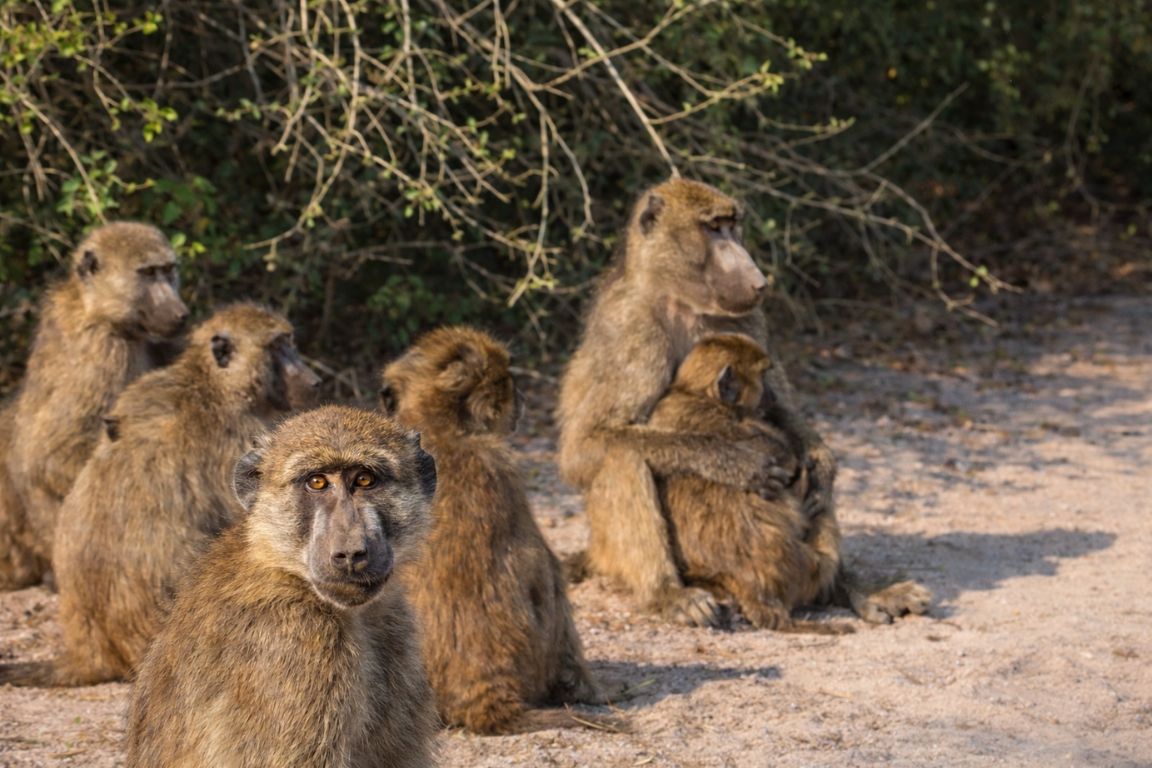
Baboons in Chobe consist of Chacma baboons living in troops of 20-100 individuals with complex social hierarchies dominated by alpha males controlling breeding access and troop movements. The troops maintain strict pecking orders where dominant individuals feed first, occupy prime resting spots, and discipline subordinates through aggressive displays or physical confrontations. Omnivorous diet includes fruits, seeds, insects, small mammals, birds, and occasional scavenging from predator kills, with baboons spending morning and afternoon hours foraging across varied habitats from riverfront through woodland to rocky outcrops. Troops commonly appear at lodges and picnic sites where human food attracts them, creating entertaining but sometimes problematic interactions requiring vigilance securing food and belongings.
Vervet monkeys represent smaller primates at 3-8kg compared to baboons’ 15-30kg, featuring gray-brown fur, black faces with white fringing, and remarkably acrobatic tree-dwelling abilities. The highly social troops of 10-50 individuals occupy riverine forests and woodland edges, moving through canopy with spectacular leaps between branches and playful juveniles performing aerial gymnastics. Vervets possess sophisticated communication including different alarm calls for specific predators (leopards, eagles, snakes) triggering appropriate escape responses in troop members. The intelligent adaptable monkeys thrive around lodges where they’ve learned human activity patterns, boldly raiding dining areas when opportunities arise and requiring constant vigilance during outdoor meals.
Mongooses include multiple species with banded mongooses in groups of 10-40 individuals being most commonly seen, featuring tan-gray coats with dark horizontal stripes across backs. The highly social groups forage together through undergrowth and open areas, constantly vocalizing with bird-like chirps and maintaining contact while searching for insects, small reptiles, and invertebrates. Dwarf mongooses at just 250-350g live in termite mounds in colonies of 10-20 animals, with endearing behaviors including sentinel duty where one individual stands upright watching for danger while others forage. Slender mongooses are more solitary at 400-800g, hunting alone or in pairs through dense vegetation rarely seen due to secretive habits.
Rock hyrax surprisingly represent closest living relatives to elephants despite resembling large guinea pigs at 2-5kg, sharing common ancestors millions of years ago before evolutionary paths diverged dramatically. The small mammals inhabit rocky outcrops, kopjes, and cliff faces where crevices provide den sites and protection from predators. Social colonies of 10-80 individuals sun themselves on rocks during mornings, producing loud screaming calls during territorial disputes or predator warnings, and forage on vegetation near rocky refuges never straying far from bolt holes. The unusual relationship to elephants shows in specialized feet with rubbery pads providing grip on rocks and continuously growing incisors resembling miniature tusks.
Porcupines emerge exclusively at night at 10-30kg as Africa’s largest rodents, featuring impressive defense systems of 30cm quills that detach easily when contacted, embedding in attackers’ flesh causing painful injuries. The nocturnal habits and cautious nature make sightings extremely rare even on night drives in private concessions, with most evidence coming from quills found along roads or distinctive digging marks where porcupines excavated roots and bulbs. When threatened, porcupines reverse toward attackers rattling quills as warning, then backing rapidly to impale predators foolish enough to ignore warnings. Lions occasionally kill porcupines but often suffer serious quill injuries in the process, with some lions developing specializations hunting porcupines while most avoid them.
Ground squirrels commonly appear at lodges and camps at 400-700g, featuring bushy tails held over backs like parasols providing shade from intense sun. The cute tail-shading behavior serves genuine thermoregulation purpose, with squirrels positioning tails to block direct sunlight while foraging on ground during hot hours. Small colonies of 5-15 individuals occupy territories around lodges, habituated to human presence and entertaining guests with upright sentinel poses, rapid digging for food, and occasionally bold approaches seeking handouts. The diurnal activity during daylight hours when most mammals rest makes ground squirrels reliable entertainment during midday lodge downtime.
Genets and civets comprise nocturnal carnivores rarely seen despite occurring throughout Chobe, with genets at 1.5-3kg featuring elegant spotted patterns, long ringed tails, and cat-like hunting behaviors. The primarily arboreal genets hunt rodents, birds, and insects through trees and ground level, occasionally appearing near lodges after dark attracted by insects around lights. African civets at 7-15kg show heavier builds with spotted-striped patterns, feeding on fruits, insects, small mammals, and carrion as opportunistic omnivores. Both species’ nocturnal habits and secretive nature make sightings rare at under 10% probability even on week-long safaris, with most encounters occurring by chance during early morning or late evening drives as animals return to or emerge from daytime resting sites.
Birds of Chobe National Park
Species diversity in Chobe exceeds 450 recorded bird species making the park one of southern Africa’s premier birding destinations, with year-round resident populations supplemented by seasonal migrants creating exceptional diversity across all months. Casual observers easily identify 80-120 species during 3-4 day safaris combining boat cruises and game drives accessing varied habitats, while serious birders targeting comprehensive lists reach 150-200+ species on week-long visits. The habitat variety from permanent river through seasonal floodplains to mopane woodland and acacia savanna supports different bird communities, with each zone hosting specialized species adapted to specific conditions.
Water birds dominate riverfront viewing with African fish eagles as Chobe’s most iconic avian species, perching prominently in riverside trees and producing distinctive yelping calls that echo across water. The white head and chest contrasting with chestnut body makes identification easy at 2.5kg size, with sightings reaching 90-95% probability on boat cruises as multiple pairs maintain territories along the river. Kingfishers include pied kingfishers hovering above water before diving for fish, tiny jewel-like malachite kingfishers perching on low branches, and giant kingfishers at 350g specializing in larger fish and crabs. Herons range from massive 1.5-meter tall goliath herons stalking shallows through elegant gray herons to secretive black-crowned night herons emerging at dusk, while storks include yellow-billed storks, marabou storks scavenging at carcasses, and migrant white storks arriving wet season in large flocks.
Raptors patrol Chobe’s skies with martial eagles as Africa’s largest at 6kg, hunting from great heights and diving on prey including small antelope, game birds, and monitor lizards. The powerful build and 2-meter wingspan create impressive silhouettes soaring on thermals, though sightings remain uncommon at 15-25% probability requiring luck spotting individuals ranging across vast territories. Bateleur eagles show distinctive rocking flight pattern with short tail and red face, patrolling woodlands hunting snakes, birds, and small mammals. Multiple vulture species including white-backed, hooded, lappet-faced, and white-headed vultures soar high using thermals to locate carcasses, with 20-40 birds descending within minutes when large predator kills are found. Owls include Pel’s fishing owl as rare specialty species hunting fish at night from riverside perches, plus barn owls, spotted eagle-owls, and pearl-spotted owlets active after dark.
Woodland species provide colorful sightings throughout interior habitats with hornbills including southern yellow-billed hornbills, African gray hornbills, and massive southern ground hornbills at 4kg walking through undergrowth. Lilac-breasted rollers display stunning blue-purple plumage perching conspicuously on exposed branches, launching aerial acrobatics during breeding displays. Carmine bee-eaters create spectacular seasonal colonies in riverbank cliffs August-November with hundreds of pairs nesting together, their brilliant red plumage and graceful flight making colonies among Chobe’s most photographed bird spectacles visible from boat cruises passing nesting banks.
Migratory birds arrive November-March adding 100+ species to resident populations as European and Palearctic migrants escape northern winters. Woodland kingfishers announce wet season with loud calls echoing through woodlands, various cuckoo species including red-chested and black cuckoos appear, and numerous warbler species occupy thickets and riverine vegetation. Intra-African migrants following seasonal rainfall include white storks in large flocks, carmine bee-eaters establishing breeding colonies, and various wetland species concentrating where seasonal water attracts insects and aquatic prey. The migration timing makes November-March optimal for dedicated birders despite compromised mammal viewing, with total diversity peaking at 400+ species present simultaneously.
| African Fish Eagle | 2.5kg, white head/chest, chestnut body, distinctive calls | Chobe River, large trees | Year-round, vocal mornings | 90-95% boat cruises |
| Pied Kingfisher | 70-110g, black-white plumage, hovering fishing behavior | Chobe River, perches over water | Year-round | 85-90% boat cruises |
| Malachite Kingfisher | 13-15g, jewel-like blue-green, tiny size | River vegetation, low branches | Year-round | 70-80% boat cruises |
| Southern Yellow-billed Hornbill | 180-270g, yellow curved bill, black-white plumage | Woodland, riverine forest | Year-round | 80-90% game drives |
| Lilac-breasted Roller | 100-130g, brilliant blue-purple plumage | Open woodland, exposed perches | Year-round | 70-80% game drives |
| Carmine Bee-eater | 25-35g, brilliant red plumage, graceful flight | Riverbank nesting colonies | August-November only | 90-95% boat cruises (when present) |
| Martial Eagle | 3-6kg, massive size, 2m wingspan | Soaring over all habitats | Year-round | 15-25% multi-day trips |
| Bateleur Eagle | 2-3kg, short tail, rocking flight, red face | Woodland, soaring | Year-round | 30-40% multi-day trips |
| White-backed Vulture | 4-7kg, bare neck, soaring high | At carcasses, soaring | Year-round | 40-60% multi-day trips |
| Goliath Heron | 4-5kg, 1.5m tall, massive gray heron | River shallows, wading | Year-round | 50-60% boat cruises |
| Marabou Stork | 4.5-8kg, massive bill, bald head | Scavenging at kills, riverfront | Year-round | 40-50% multi-day trips |
| Woodland Kingfisher | 60-80g, bright blue wings, loud calls | Woodland, riverine forest | November-March migrants only | 70-80% (wet season) |
Rare and Unusual Animals
Wild dogs rank among Africa’s most endangered large carnivores with only 6,000-7,000 remaining continent-wide, making Chobe sightings at 10-20% probability on multi-day safaris privileged encounters with critically threatened species. The packs of 8-15 individuals roam territories exceeding 400-800 square kilometers hunting cooperatively using stamina-based pursuit tactics, chasing prey at sustained 40-50 km/h speeds for several kilometers until exhaustion allows killing. The distinctive tricolored coats with unique patterns on each individual, large rounded ears, and enthusiastic greeting ceremonies with high-pitched vocalizations make wild dog encounters unforgettable despite rarity.
Cheetahs appear uncommonly in Chobe at 5-15% sighting probability as the park’s predominantly woodland habitat doesn’t suit these open-plains specialists requiring extensive short-grass areas for acceleration-based hunting. The slender builds, solid spot patterns (versus leopard rosettes), distinctive black tear marks from eyes to mouth, and diurnal hunting during cooler mornings distinguish cheetahs when rare sightings occur on floodplain grasslands. Competition from larger predators including lions and spotted hyenas that steal kills and occasionally kill cheetahs makes Chobe marginal habitat where these cats struggle compared to thriving in ideal Serengeti-type environments.
Aardvarks and pangolins represent extremely rare nocturnal specialists with under 5% sighting probability even on week-long safaris including night drives. Aardvarks at 40-65kg feature pig-like snouts, powerful digging claws, and exclusively nocturnal habits hunting termites and ants, emerging after dark from underground burrows to forage across vast territories. Pangolins at 5-18kg covered in protective scales represent the world’s only scaled mammals, feeding exclusively on ants and termites using long sticky tongues, curling into defensive balls when threatened. Both species’ nocturnal activity, secretive nature, and solitary habits combine with genuinely low population densities making encounters exceptional luck rather than realistic expectations.
Servals and caracals comprise elusive small cat species with under 10% sighting odds due to predominantly nocturnal habits and preference for dense vegetation providing concealment. Servals at 8-18kg feature golden coats heavily spotted with black, exceptionally large ears, and long legs adapted for hunting in tall grasslands and reed beds through spectacular vertical leaps locating rodent prey by sound. Caracals at 8-19kg show uniform tan coats, distinctive long black ear tufts, and powerful builds allowing prey up to small antelope size though typically hunting birds, rodents, and hares. Both species maintain territories throughout Chobe but remain largely invisible to daytime safari activities, with brief dawn or dusk sightings representing lucky exceptions.
Honey badgers justify fearless reputations through aggressive defense against threats regardless of size, attacking lions, buffalo, and elephants when cornered or protecting young. The stocky muscular builds at 9-16kg, powerful claws for digging, and thick loose skin protecting from bites and stings allow honey badgers to raid bee hives, hunt venomous snakes, and excavate burrowing prey other predators cannot access. Primarily nocturnal activity makes sightings rare despite widespread distribution, with dawn or dusk encounters providing memorable experiences watching these compact carnivores fearlessly going about their business.
African wild cats remain Africa’s only small wild feline beyond servals and caracals at just 3-6kg, resembling domestic cats but with longer legs, larger ears, and distinctive reddish backs of ears. The strictly nocturnal habits, extremely shy nature avoiding humans, and preference for dense vegetation cover make sightings exceptionally rare at under 5% probability. The cats hunt rodents, birds, and insects primarily at night, resting during day in burrows, hollow logs, or dense thickets where they remain largely undetectable. Most safari visitors never encounter African wild cats despite the species occurring throughout Chobe.
Water monitors provide impressive reptilian encounters as Africa’s largest lizards reaching 1-2 meters total length including long powerful tails, weighing 5-15kg with exceptional specimens exceeding 20kg. The dark gray-brown coloring with yellow spots, forked tongues constantly flicking sensing environment, and semi-aquatic habits along riverbanks and near water make monitors regularly visible during boat cruises and riverfront game drives. The lizards hunt fish, frogs, birds, eggs, and carrion, swimming powerfully using laterally compressed tails as propulsion and climbing trees with strong claws. Sighting odds reach 40-60% on multi-day safaris as monitors bask on riverbanks, patrol shorelines hunting, or swim across channels visible from boats.
FAQ: Animals of Chobe
1. What animals can you see in Chobe National Park?
Elephants (50,000+, virtually guaranteed), lions (60-80% multi-day odds), leopards (25-40%), buffalo herds (80-90%), hippos and crocodiles (95-99% on boat cruises), giraffe (60-80%), diverse antelope (impala 99%, kudu 70-90%, waterbuck 60-80%), wild dogs (10-20%), zebra, warthogs, baboons, and 450+ bird species. Four of Africa’s Big Five present (elephant, lion, leopard, buffalo – no rhinos).
2. How many elephants are in Chobe?
Over 50,000 elephants making Chobe the world’s largest concentration. Dry season gatherings routinely show 200-400 animals at afternoon river sessions, with exceptional days exceeding 500+ elephants visible along 10-15km riverfront stretches. The massive population creates daily spectacular encounters impossible to witness anywhere else on Earth.
3. Are there lions in Chobe?
Yes, multiple prides throughout the park with 60-80% sighting probability on multi-day dry season safaris. Best viewing occurs early morning 6-8am after overnight hunts or late afternoon 3-5pm as lions wake and become active. Riverfront ambush sites near waterholes provide reliable lion territories where prides hunt concentrated prey.
4. What is the most dangerous animal in Chobe?
Hippos kill more humans annually (500+ across Africa) than any large animal through unpredictable aggression, territorial attacks on boats, and encounters on land during nightly grazing. Buffalo rank second as unpredictable 700-900kg animals with sharp horns attacking when threatened. Crocodiles, elephants, and lions also dangerous but cause fewer human fatalities than hippos.
5. Can you see leopards in Chobe?
Yes, with 25-40% sighting probability on 3-4 day safaris, though patience and luck required. Best times are dawn 5:30-7am and dusk 5-6:30pm in dense riverine thickets and woodland edges. Leopards are solitary, largely nocturnal, and excellently camouflaged making them among safari’s most prized sightings despite reasonable populations.
6. Are there rhinos in Chobe?
No, Chobe has zero rhinos making it four of Big Five (elephant, lion, leopard, buffalo) but missing rhinos. Historical rhino populations were eliminated by hunting before park establishment, and reintroduction hasn’t occurred due to poaching concerns and habitat suitability questions. For rhinos, visit South Africa’s Kruger or private reserves.
7. What is the best time to see animals in Chobe?
Dry season May-October delivers best viewing as water scarcity concentrates animals at Chobe River creating 95-99% elephant encounter rates, 70-80% lion odds, and spectacular densities. Peak July-September offers maximum concentrations. Early morning 6-9am and late afternoon 3-6pm provide optimal activity periods when animals feed, hunt, and move rather than resting midday heat.
8. What is special about Chobe wildlife?
World’s largest elephant concentration (50,000+) with daily herds of 200-400 animals, unique river safaris by boat viewing hippos/crocodiles/swimming elephants, four of Big Five in accessible riverfront habitat, 450+ bird species, and reliable dry season wildlife concentrations creating 95%+ major species encounter rates. The combination of quantity and quality makes Chobe exceptional.
Glossary: Chobe Wildlife Terms
Big Five: Term referring to Africa’s five most dangerous game animals to hunt on foot – lion, leopard, elephant, buffalo, and rhinoceros. Chobe has four of five (no rhinos), with elephants and buffalo in massive numbers, lions regularly seen, and leopards present but elusive. Historical hunting term now used in safari tourism marketing.
Herbivore vs Carnivore vs Omnivore: Herbivores (elephants, buffalo, antelope) eat only plants, carnivores (lions, leopards, wild dogs) eat only meat, omnivores (baboons, warthogs, honey badgers) eat both plants and animals. Understanding diet types helps predict where species feed and when they’re active.
Pride: Lion social group of related females, their cubs, and 1-3 resident males, typically 5-15 individuals. Females remain together for life hunting cooperatively and raising young communally, while males control territories 2-4 years before younger coalitions displace them.
Pod: Hippo social group of 20-100 individuals occupying defined river territory controlled by dominant territorial bull. Cows and calves form stable units within territories, with subordinate males tolerated if showing submission. Pods remain in same river sections year-round.
Herd: Large group of elephants or buffalo traveling together. Elephant herds are matriarchal family groups of 8-20 related females and young led by experienced cows. Buffalo herds range from bachelor groups of 10-50 bulls to breeding herds of 100-500 animals to massive dry season aggregations exceeding 1,000 individuals.
Nocturnal vs Diurnal vs Crepuscular: Nocturnal animals (leopards, honey badgers, genets) are active at night. Diurnal species (elephants, impala, most birds) are active during day. Crepuscular animals (lions, leopards partially) show peak activity at dawn and dusk twilight periods.
Endangered vs Threatened vs Vulnerable: IUCN conservation status categories indicating extinction risk. Endangered species (wild dogs) face very high risk. Threatened is general term for at-risk species. Vulnerable species face high risk but less immediate than endangered. Categories guide conservation priorities and protections.
Ready to Experience Chobe’s Incredible Wildlife?
Chobe’s wildlife diversity combines world’s largest elephant concentration (50,000+ individuals with daily herds of 200-400), big cats including lions (60-80% sighting odds), elusive leopards (25-40%), and rare wild dogs (10-20%), massive buffalo herds numbering thousands, river giants with resident hippo pods and giant crocodiles throughout the Chobe River, diverse antelope from impala through magnificent kudu to impressive sable, and 450+ bird species from iconic fish eagles to spectacular carmine bee-eater colonies. The combination of guaranteed elephants and hippos with highly probable lions and buffalo alongside moderately likely leopards creates comprehensive wildlife experiences unmatched in southern Africa.
Start with a full-day Chobe safari that includes a river cruise if you want a guided day in the habitats this page covers. On a private full-day Chobe safari the guide can explain why animals are behaving as they are and how they fit the riverfront and woodland habitats.
At Chobe Tours, our guides have spent years observing these animals across every season, learning individual elephants by ear patterns and tusk shapes, understanding which riverfront sections host resident leopards, recognizing lion pride territories and social dynamics, and knowing where rare species like wild dogs appear when ranging through the area. Guides on the full-day Chobe safari with border logistics included handle routing and timing, so you can watch the animals rather than manage the crossing.
Book your Chobe safari at chobetours.com where expert guides sharing deep wildlife knowledge enhance every encounter, helping you appreciate Chobe’s incredible animal diversity from flagship elephants through elusive leopards to spectacular bird colonies along the river.
The elephants are here in numbers impossible elsewhere. The lions hunt riverfront ambush sites. The leopards rest in riverine thickets. The question is when you’ll experience them yourself.
From the guides at Chobe Tours who’ve watched elephant herds for years learning individual personalities, tracked leopards to favorite trees where they rest predictably, observed lion pride dynamics through successive generations, and witnessed rare wild dog encounters that still create excitement despite decades guiding these incredible animals through intimate daily observation.